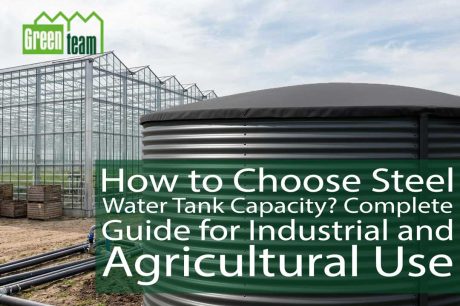
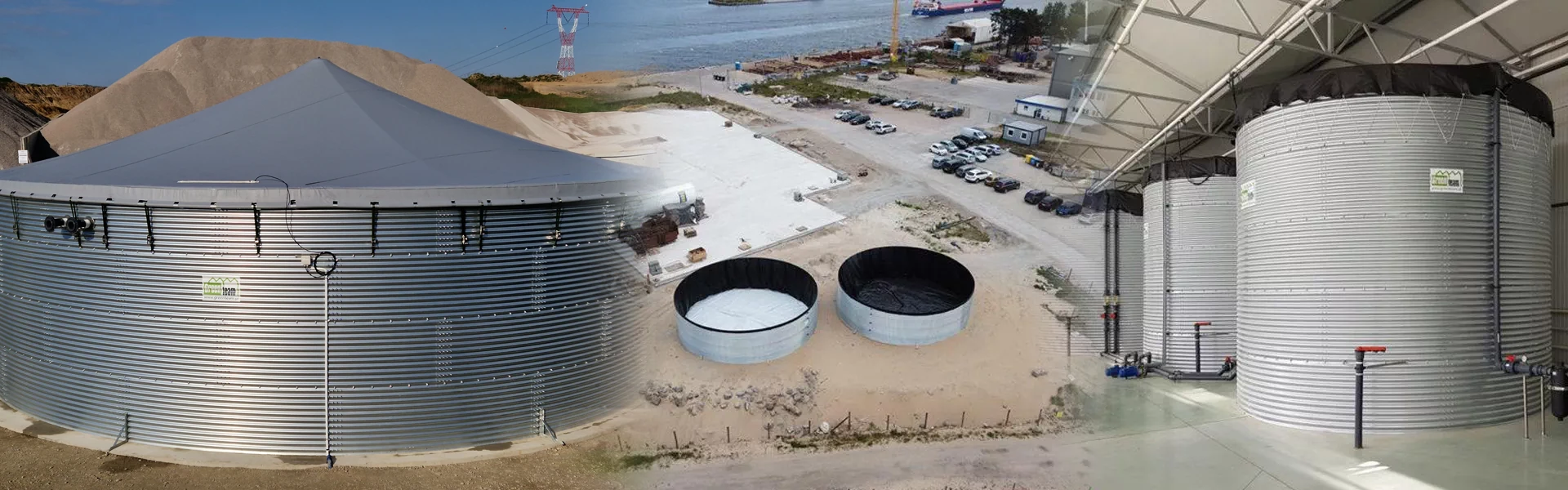
Corrugated steel tanks manufactured by Green Team are available in capacities ranging from 5 m³ to 3,143 m³, allowing precise adaptation to agricultural, industrial, and municipal infrastructure projects.
Why Is Proper Tank Capacity Selection So Important?
The capacity of a steel tank directly affects:
- continuity of water supply or stored liquid availability,
- operational safety and system reliability,
- efficiency of irrigation and production processes,
- compliance with technical and fire protection requirements,
- investment and operational cost efficiency,
- protection against drought, supply interruptions, or emergency situations.
Modern steel tanks made from high-strength S550GD structural steel with Z600 galvanization (600 g/m² zinc coating) provide exceptional corrosion resistance and a service life exceeding 20 years, even in demanding environmental conditions.
How to Calculate the Required Steel Tank Capacity
The required capacity depends primarily on daily water consumption and system operational requirements.
1. Determine Daily Water Demand
The first step is calculating the daily water usage of your system.
- industrial greenhouses: 5–50 m³ per day,
- agricultural farms: 10–200 m³ per day,
- industrial facilities: 50–500 m³ per day,
- fire protection systems: from 50 m³ to over 1,000 m³.
2. Include Safety Reserve Capacity
A reserve capacity of 20–50% is recommended to ensure operational continuity.
Formula:
Tank Capacity = Daily Consumption × (1 + Reserve % / 100)
Example:
- daily consumption: 100 m³
- reserve: 30%
- recommended tank capacity: approx. 130 m³
3. Consider Operational and Infrastructure Requirements
For systems requiring continuous operation, such as greenhouse irrigation or industrial processes, larger tank capacities ensure stable and reliable performance.
Typical Steel Tank Capacities and Applications
| Capacity | Typical Applications |
|---|---|
| 5–50 m³ | Small farms, rainwater harvesting, small-scale industrial use |
| 50–200 m³ | Agricultural irrigation, greenhouse infrastructure, water storage systems |
| 200–1000 m³ | Industrial greenhouses, production facilities, industrial infrastructure |
| 1000–3143 m³ | Fire protection systems, large-scale industry, municipal infrastructure |
Steel Tank Capacity Selection for Industrial Greenhouses
Industrial greenhouse tank capacity depends on cultivation area, irrigation intensity, and production requirements.
- 1 hectare greenhouse – 100–300 m³ tank
- 5 hectare greenhouse – 500–1500 m³ tank
- large greenhouse complexes above 10 hectares – tanks exceeding 2000 m³
Modular corrugated steel tanks allow precise customization based on operational needs.
Common Mistakes When Choosing Tank Capacity
- selecting insufficient capacity without safety reserve,
- not considering future infrastructure expansion,
- choosing tanks based only on price, not durability,
- ignoring seasonal variations in water demand.
Why Corrugated Steel Tanks Are the Optimal Solution
- long service life exceeding 20 years,
- high corrosion resistance due to Z600 galvanization,
- compatibility with EPDM, HDPE, and PVC liners,
- modular design enabling fast installation,
- scalable capacity to match project requirements.
FAQ – Frequently Asked Questions
What tank capacity is recommended for industrial greenhouses?
Typically between 100 m³ and 1500 m³ depending on greenhouse size and irrigation intensity.
How long does a steel water tank last?
Corrugated steel tanks made from S550GD steel with Z600 galvanization provide over 20 years of reliable service life.
Can steel tanks be expanded in the future?
Yes. Modular construction allows system expansion based on operational needs.
Choose the Right Steel Tank for Your Investment
Selecting the correct steel tank capacity ensures operational reliability, safety, and long-term cost efficiency. Green Team provides complete engineering support, manufacturing, and installation of corrugated steel tanks for agricultural, industrial, and infrastructure applications.
Explore available solutions:
Corrugated Steel Tanks – Green Team Offer